"There's a piano in the house"
Often inherited, often beautiful, and nobody has touched it in years. Learning to play the instrument already sitting in your front room is a particularly satisfying place to begin.

Home / Piano Lessons for Seniors
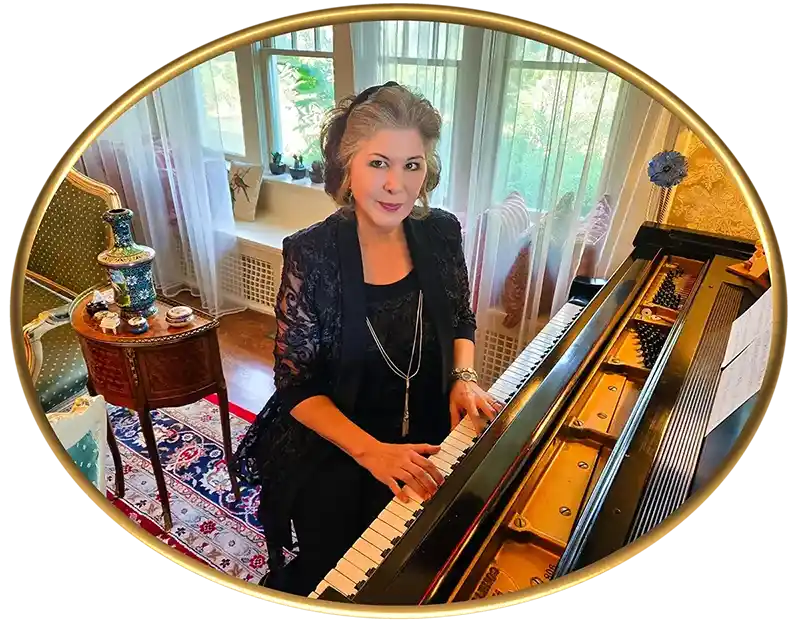
Retirement is the first time many people have both the hours and the permission to learn something purely because they want to. Julie teaches students in their sixties, seventies and eighties in person at Jewel Tone Studio, on acoustic pianos, at whatever speed suits — with no exams to sit and nobody to keep up with.
How lessons are adapted
On memory and the mind
Learning an instrument is one of the more demanding things an adult can ask of the brain, and the people who study aging have noticed. A Mayo Clinic neurosurgeon calls the performance of music “one of the higher functions that a human brain can engage with,” and notes that as you master an instrument “there are certain connections that grow and get enhanced in the brain.” The Cleveland Clinic lists better hand-eye coordination, motor skills and brain connectivity among the benefits of learning to play. AARP reports that taking up an instrument after fifty is associated with better attention and thinking skills, and the National Institute on Aging describes growing scientific interest in music's effects on the brain and body as we age.
Two studies looked at piano specifically. A 2022 randomized trial of adults aged 60 to 80 reported gains in some executive-function measures, and in mood and wellbeing, after sixteen weeks of piano training. A one-year piano-practice study in healthy older adults examined cognitive flexibility over a full year at the keys. Both are small, both are careful, and neither claims a cure for anything.
Here is the honest version: piano lessons are music education, not medical care. Julie is a piano teacher, not a clinician. Nothing here treats, prevents or slows any condition, and the National Institute on Aging itself says “much more research is needed before any definitive conclusions can be drawn.” If you have concerns about your memory, please talk to your doctor.
What lessons reliably offer is a weekly half hour of concentration, two hands doing two different things at once, something new every week, and a skill that grows for as long as you keep at it. Students tend to say they feel sharper. Whether or not the research bears that out for you personally, the music is worth it on its own.
Read it yourself
We link to what researchers actually found and try not to overstate it. If a source above ever moves, tell us and we'll fix the link.
What students tell her
Often inherited, often beautiful, and nobody has touched it in years. Learning to play the instrument already sitting in your front room is a particularly satisfying place to begin.
After decades of work and raising a family, a weekly half hour that belongs entirely to you is not a small thing. Several students describe it as the appointment they protect most.
Not as medicine — just as the pleasure of getting better at something difficult. Piano gives you a new small problem to solve every single week.
Getting started
Call or text 940-50-PIANO and talk to Julie about where you're starting from. There's no obligation.
Your first lesson is at Jewel Tone Studio, at the bench, on an acoustic piano. Bring nothing but yourself.
A relaxed half hour before you decide anything else. No obligation, no paperwork.
Thinking of this for a parent or grandparent? A gift certificate is a gentle way to offer it.
Begin
Tell Julie a little about yourself — whether you've played before, and what you'd love to play — and she'll be in touch about a first lesson at Jewel Tone Studio.
Prefer to talk? She'd love to hear from you.
(940) 507-4266 · call or text